Investing in Home Comfort
There is nothing quite like the relief of walking into a perfectly cooled home on a humid July afternoon. However, that crisp breeze comes with a price tag that can often feel a bit mysterious to the average homeowner.
In 2026, the cost to install a central air conditioning system typically ranges between $5,000 and $12,500. While that is a significant window, the final number depends on your home’s size and the existing “skeleton” of your HVAC system.
Think of an AC installation like buying a new engine for a car. You aren’t just paying for the metal box; you’re paying for the specialized labor to integrate it with the electrical and ventilation systems already in place.
The Core Cost Components
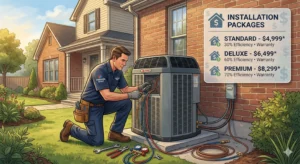
When you look at a professional quote, the total is usually split into three main categories: the unit itself, the labor for installation, and any necessary modifications to your home’s ductwork.
The unit price is driven by “Tonnage” (cooling capacity) and the SEER2 rating (efficiency). A unit with a higher SEER2 rating might cost more upfront, but it acts like a fuel-efficient car, saving you money on every monthly utility bill.
Labor typically accounts for 40% to 50% of the total project. This isn’t a simple plug-and-play appliance; it requires a licensed professional to handle refrigerant, high-voltage electricity, and precise drainage lines.
Understanding Capacity and Efficiency
One of the most common mistakes is assuming a “bigger” unit is better. In reality, an oversized AC unit will “short cycle,” turning on and off too quickly, which leads to uneven cooling and a shorter lifespan for the equipment.
HVAC pros use a “Manual J Calculation” to determine the exact size you need. This takes into account your home’s square footage, the number of windows, and even the quality of your insulation.
Efficiency is measured by SEER2 (Seasonal Energy Efficiency Ratio). In 2026, the minimum standards have risen. While a 14.3 SEER2 unit is the baseline, many homeowners opt for 18 or 20 SEER2 units to combat rising energy prices.
Standard Installation Cost Estimates
To help you visualize the budget, here is a breakdown of what you might expect for different home sizes using mid-range efficiency equipment.
| Home Size (Sq. Ft.) | System Size (Tons) | Estimated Total Cost |
|---|---|---|
| 1,000 – 1,500 | 2.0 – 2.5 Tons | $5,000 – $7,500 |
| 1,600 – 2,200 | 3.0 – 3.5 Tons | $7,000 – $10,500 |
| 2,500 – 3,500 | 4.0 – 5.0 Tons | $9,500 – $13,500 |
Keep in mind that if your home currently lacks ductwork, you may need to look into ductless mini-split systems or prepare for an additional $3,000 to $8,000 in duct installation costs.
The Hidden Variables
Every home has its quirks. If your electrical panel is maxed out, you might need an upgrade to handle the new AC load, which can add $1,500 to $2,500 to your initial estimate.
Similarly, the location of the unit matters. If the installer has to crane a unit onto a roof or navigate a very tight crawlspace, the labor hours will climb quickly. Always ask for an itemized quote to see these specifics.
Don’t forget the permit fees. Most municipalities require a mechanical permit for AC installation. While usually only $100 to $300, it is a necessary step to ensure the installation meets local safety and environmental codes.
2026 Industry Statistics
Understanding the current market trends can help you decide when and how to buy. Here are a few key figures currently shaping the HVAC landscape.
- Energy Savings: Upgrading from a 10-year-old unit to a modern high-efficiency system can reduce cooling costs by 20% to 40%.
- Home Value: A new central AC system can increase a home’s resale value by an average of 3% to 5% in warmer climates.
- Refrigerant Shifts: Systems in 2026 use more eco-friendly refrigerants, which are better for the planet but can slightly increase the cost of the initial equipment.
Strategic Ways to Lower Your Costs
Timing is everything. Most people wait until their AC dies on a 95-degree day to call a contractor. This is when prices are highest and wait times are longest.
Try scheduling your installation in the “shoulder seasons” of spring or fall. Many contractors offer rebates or lower labor rates during these slower months to keep their crews busy.
Also, look into federal and state tax credits. The Inflation Reduction Act and similar 2026 local initiatives often provide substantial credits for installing high-efficiency heat pumps and AC units.
Final Thoughts
While the upfront cost of central air conditioning can be daunting, it is an investment in both your property value and your daily quality of life. A well-installed system should last 15 to 20 years with proper maintenance.
Take the time to get at least three quotes and check recent reviews for local installers. The “cheapest” bid is rarely the best if it results in a poorly sized system or shoddy electrical work that fails in three years.
By understanding the tonnage, efficiency, and labor factors involved, you can walk into your consultation with confidence and secure a cooling solution that fits your budget and your home perfectly.