Understanding the Foundation of Your Home’s Strength
When you think about your home, you probably focus on the paint colors or the kitchen tiles. However, the real hero is hidden behind the drywall: the structural beam.
These beams carry the heavy weight of your floors, roof, and walls. If one starts to sag or crack, it’s not just a cosmetic issue; it’s a call to action for your home’s safety.
Replacing a beam can feel like a daunting task, especially when you start wondering about the price tag. This guide is here to walk you through the costs with a steady, helpful hand.
Whether you are dealing with termite damage or opening up a floor plan, knowing the financial landscape helps you plan with confidence and avoid nasty surprises.
The Big Picture: Average Replacement Costs
Let’s talk numbers right away. On average, most homeowners will spend somewhere between $1,500 and $5,000 for a standard structural beam replacement project.
This range covers the basics, but complex jobs—like those involving massive steel supports or multi-story load shifts—can easily climb above $10,000 to $15,000.
Think of it like buying a car; a reliable sedan (a simple wood beam) costs much less than a heavy-duty semi-truck (a massive custom steel I-beam).
Breaking Down the Material Costs
The type of beam you choose is one of the biggest factors in your final bill. Different materials offer different strengths and come with unique price points.
Wood and LVL Beams
Laminated Veneer Lumber (LVL) is a popular modern choice. It is engineered for strength and is much more stable than traditional solid wood timber.
Expect to pay around $5 to $30 per linear foot for wood-based beams. For a 20-foot span, that’s roughly $100 to $600 just for the material itself.
These are great for standard residential spans, like if you’re removing a non-load-bearing wall to slightly expand a laundry room or a small closet.
Steel I-Beams
When you need to support massive weight over a long distance, steel is the gold standard. It is incredibly strong but significantly heavier and more expensive.
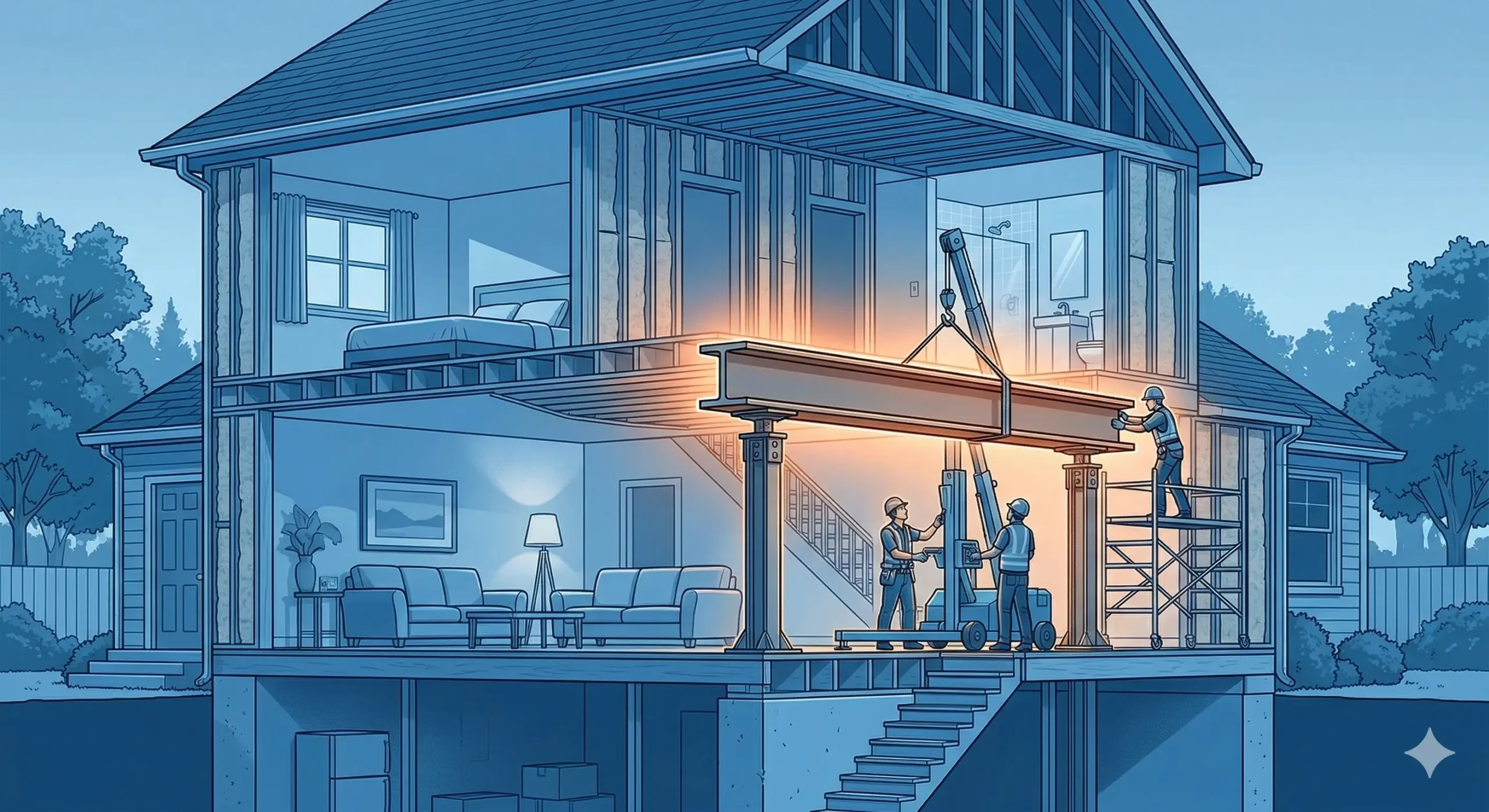
Steel beams generally cost between $10 and $100 per linear foot. Because they are so heavy, they often require a crane or special lifts to get into place.
Imagine you’re creating a massive open-concept Great Room. You’ll likely need the uncompromising strength that only a steel beam can provide for that wide gap.
Labor: The Invisible Part of the Invoice
You aren’t just paying for a piece of metal or wood; you are paying for the expertise of people who keep your house from falling down while the work happens.
Labor typically accounts for 60% to 70% of the total project cost. This includes the setup of temporary “shoring” walls to hold the house up during the swap.
A professional crew might charge $200 to $500 per hour. While that sounds high, their precision ensures your windows don’t crack and your doors still close properly later.
The Importance of Professional Guidance
Before a single hammer swings, you need a plan. This is where structural engineers and permits enter the equation to keep everything legal and safe.
Structural Engineering Fees
An engineer will visit your home, calculate the loads, and specify exactly what size beam you need. This isn’t a place to guesstimate or use “gut feelings.”
Engineering reports usually cost between $500 and $1,500. Think of this as an insurance policy that guarantees your new beam is up to the task.
Permits and Inspections
Since this work affects the building’s integrity, your local city hall will want to see the plans. Permit fees vary by location but usually run $100 to $500.
Failing to get a permit can lead to massive headaches when you try to sell your home later. It’s always better to do things by the book from day one.
Hidden Costs to Keep on Your Radar
The beam replacement itself is just the “middle” of the sandwich. There are often costs associated with getting to the beam and cleaning up afterward.
- Demolition: Removing the old drywall and existing studs to reach the work area ($500 – $1,000).
- Utility Rerouting: If there are wires or pipes inside the wall you’re removing, an electrician or plumber must move them ($600 – $2,500).
- Finishing Work: Once the beam is in, you’ll need new drywall, paint, and perhaps crown molding to hide it ($1,000 – $3,000).
- Shoring: Building the temporary “jack walls” that hold your ceiling up while the old beam is removed ($500 – $1,500).
A Quick Comparison Table
| Factor | Estimated Cost (Low) | Estimated Cost (High) |
|---|---|---|
| Materials (Beam) | $200 | $2,500 |
| Labor & Install | $1,000 | $6,000 |
| Structural Engineer | $400 | $1,200 |
| Permits | $100 | $500 |
Helpful Notes for Homeowners
As you prepare for this journey, keep these small but mighty tips in mind to ensure the process goes as smoothly as possible.
Note: Always check for signs of moisture or rot before the crew arrives. If the beam failed because of a leak, you must fix the leak first!
Note: Steel beams are noisy to install. If you work from home, you might want to find a coffee shop for the day they do the heavy lifting.
Note: Ask your contractor if they carry “Builders Risk” insurance. It provides extra protection specifically for major structural alterations like this.
Conclusion: Investing in Peace of Mind
Replacing a structural beam is a significant investment, but it is one that directly protects your family and your home’s long-term resale value.
While the $1,500 to $5,000 average price range is a good starting point, remember that every house has its own unique personality and structural needs.
Take the time to hire a licensed engineer and get multiple quotes from experienced contractors. A sturdy home starts with a solid plan and a very strong beam.
You’ve got this! By staying informed and asking the right questions, you can turn a stressful structural repair into a successful home improvement win.